


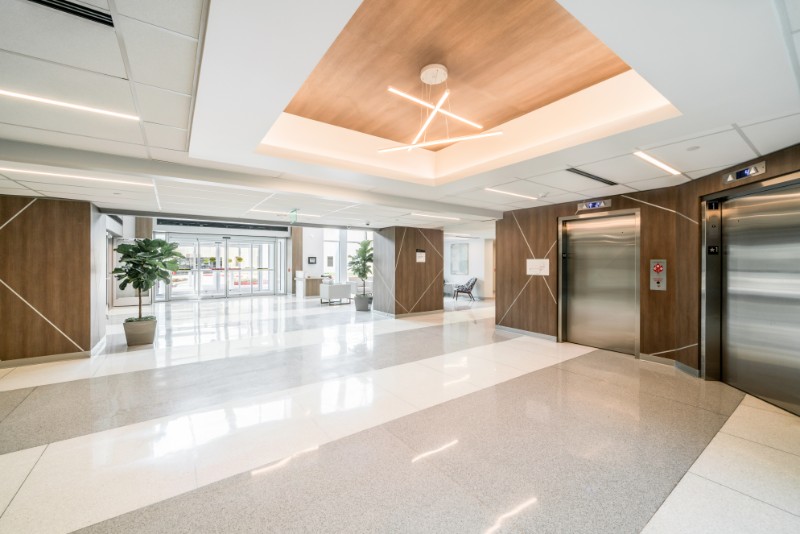
Think about the last time you were in a hospital not as a visitor, but as someone who needed to be there.
Not passing through but waiting. Watching the clock. Sitting with uncertainty.
What stays with you is rarely the architecture in any explicit sense. It is how the space felt. Whether it brought a sense of calm or quietly heightened the tension. Whether it helped you understand where you were, or made everything feel more uncertain.
More often than not, that experience was shaped by light.
Light does not appear in care plans or operational metrics. Yet it is present in every room, across every shift quietly influencing how patients recover, how staff perform, and how families endure waiting.
In that way, it becomes part of care itself. The quietest member of the care team.
Designing with Light in Mind
We register light instinctively. A corridor with access to daylight feels easier to move through. A waiting area with softened contrast feels calmer, more contained. A clinical space with clear, balanced illumination communicates focus, control, and reassurance.
These responses happen before we consciously process them, yet they shape how we move, how we feel, and how we interpret a space.
In healthcare environments where emotions are heightened and attention is divided those cues carry weight.
Light is not only visual. It is biological. It regulates circadian rhythms, guiding sleep, alertness, and recovery. When these cues are absent or inconsistent, the effects are tangible: disrupted rest, increased fatigue, reduced clarity.
A patient room that receives morning light offers orientation a quiet reminder that time is moving forward. A clinical environment that adapts through night shifts helps sustain focus without strain.
Designing with light, then, is not simply about illumination. It is about aligning architecture with the body’s natural rhythms, and supporting people through moments that are often uncertain and deeply personal.
Balancing Performance and Experience
Healthcare environments must perform continuously, often under pressure.
Lighting plays a critical role in that performance. It must support precision without creating fatigue, clarity without harshness, and comfort without compromise.
For clinicians, this means maintaining visual accuracy across long hours.
For patients and families, it means spaces that reduce stress and make waiting more bearable.
These needs are not in conflict; they require careful calibration.
Achieving that balance depends not only on fixtures or specifications, but on how light is integrated into the architecture itself, how it reflects across surfaces, transitions between spaces, and adapts to different functions within a single environment.
Designing Early, Designing Intentionally
The impact of light is determined early.
By the time lighting systems are selected, many of the most important decisions have already been made—building orientation, depth of floor plates, placement of openings, and spatial relationships. These choices define how light enters, moves, and changes throughout the day.
When light is considered from the outset, it becomes part of the architectural strategy. Natural and artificial systems work together, supporting clarity, efficiency, and comfort.
When it is addressed later, it is often left to compensate.
Healthcare design requires more than aesthetics. It requires precision, empathy, and operational intelligence. Every decision spatial, technical, and environmental must support both care delivery and long-term performance.
From imaging and diagnostic centers to multi-tenant medical office buildings, these environments must remain efficient, adaptable, and responsive to evolving models of care.
Within that complexity, light becomes one of the most powerful tools available not as an isolated feature, but as part of a cohesive architectural approach that supports both clinical outcomes and human experience.
When it’s designed with intention, light becomes the quietest, most consistent member of the care team.
The spaces we build either support that experience, or they don’t.
There is no neutral.