

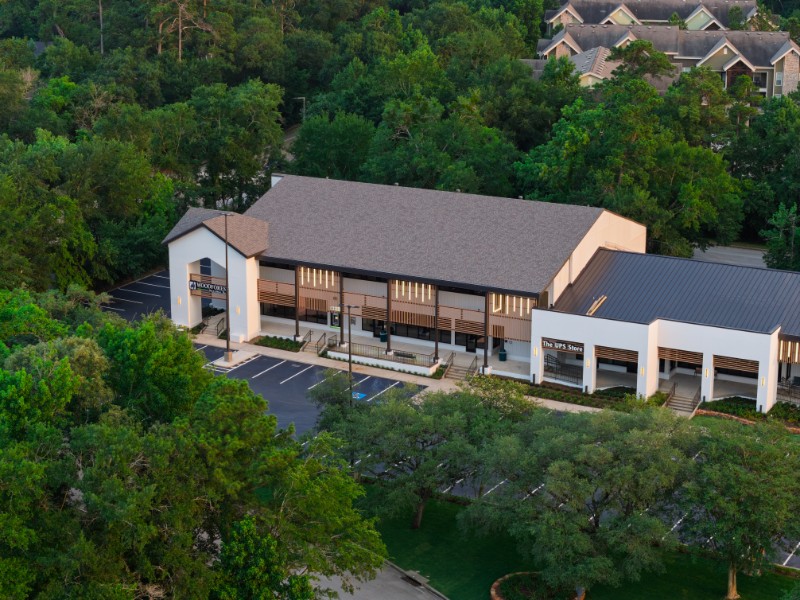
In the late 1970s, Grogan’s Mill Village Center emerged as one of the earliest gathering places in The Woodlands. Known then as The Wharf, the center opened in 1978 with shops, restaurants, and even an ice rink quickly becoming a destination for residents of a young and growing community.
Families stopped by the village center on their way home from work. Children learned to skate at the rink while parents wandered through nearby shops, and neighbors crossed paths running errands or meeting friends for dinner. The center was more than a collection of buildings; it was part of the rhythm of community life.
Communities evolve.
Over the decades that followed, The Woodlands expanded. New retail corridors emerged. New districts developed across the region. Gradually, the center that once anchored everyday activity began to fade into the background of the community it had helped shape.
Its foundations remained sound. Its location, often irreplaceable. What had changed was the way people moved through it.
Cities rarely begin again from nothing.
More often, they evolve through layers buildings designed for one generation gradually adapting to the needs of the next. Retail centers, office campuses, and civic gathering places often outlive the moment that first gave them purpose.
What changes is how people live, gather, and move through space.
This is where adaptive reuse becomes more than a design strategy. It becomes an act of renewal.
Across the industry, architects and developers increasingly recognize the enduring value embedded within existing buildings and structures. These environments hold more than physical assets they carry infrastructure, recognizable character, and longstanding connections to the communities around them.
Adaptive reuse allows these environments to evolve rather than disappear. It preserves resources while sustaining the architectural relationships that already exist.
Transforming existing environments, however, requires more than design imagination.
Buildings reveal themselves slowly. Structural limitations, aging infrastructure, and operational constraints often surface only after design work has begun. What may appear straightforward in the early stages can grow more complex as the building gradually reveals its realities.
Successful adaptive reuse depends not only on creativity, but on how that creativity is carried through delivery.
When architects, construction teams, permitting authorities, and ownership coordinate early, ideas gain resilience. Clear communication keeps stakeholders aligned. Design exploration becomes grounded in feasibility, allowing architectural intent to remain intact as projects move from concept to construction.
Architecture succeeds when process and creativity move in rhythm. But beyond coordination and execution lies another essential element: exploration.
Before redevelopment begins, schematic design teams develop conceptual perspectives that allow owners to evaluate multiple directions for their properties. These studies are not merely aesthetic exercises. They test how different strategies perform within real constraints—site conditions, tenant expectations, operational needs, and budget considerations.
Through this process, stakeholders begin to see potential futures for their assets before committing to a final path. Rather than narrowing possibilities too early, conceptual exploration allows ideas to unfold gradually revealing which directions respond most thoughtfully to the conditions already present within the built environment.
Behind these early explorations, technical coordination plays a quiet but critical role. Existing properties require careful navigation of permitting frameworks, infrastructure limitations, and evolving municipal requirements. When permitting expertise is engaged early, design ideas can be evaluated against regulatory realities ensuring that creativity remains aligned with what can ultimately be delivered.
In this way, creativity is not diminished by the process. It is strengthened by it.
Projects delivered through this level of coordination move forward with greater clarity. Redesign cycles are minimized, construction progresses more smoothly, and outcomes remain closer to the original vision, schedule, and budget.
This rhythm becomes especially important in redevelopment work, where existing environments must evolve without losing the identity that made them meaningful in the first place.
Projects such as Grogan’s Mill Village Center recognized with Development of Distinction honors by the Urban Land Institute and The Quad at Brittmoore, a finalist for the Houston Business Journal Landmark Award, illustrate how thoughtful repositioning can extend the life and relevance of existing assets.
In both cases, the work moved beyond aesthetic updates. The focus was on redefining how people interact with the environment how they arrive, how they move through space, and how the architecture supports evolving tenant experiences.
At ORN Plaza District in the City of Oak Ridge North, the conversation expands further. Rather than choosing between preservation or new construction, the project allows both to unfold together. Existing warehouse structures are being adaptively reused while new buildings emerge alongside them allowing the character of the past to inform future growth.
Equally important is how the district begins to function as a place rather than simply a property. Circulation, gathering areas, and tenant interaction are being reconsidered so the environment can evolve into a more cohesive destination within the community—an example of how redevelopment can strengthen placemaking while preserving identity.
Moments like these reveal the deeper value of adaptive reuse.
Buildings are rarely finished stories.
They are frameworks capable of evolving as the communities around them evolve structures that can adapt, transform, and continue serving the places that once gave them life.
Architecture, in this sense, is not about replacing what is outdated. It is about recognizing the value already embedded within the built environment and applying the discipline, collaboration, and creativity required to shape its next chapter.
In many redevelopment projects today, this level of coordination increasingly unfolds through architect-led design-build approaches where design expertise and delivery strategy develop together.
When process and creativity remain aligned, exploration becomes more productive, and projects are better positioned to carry their original vision forward.