

UT Physicians Pediatric Multispecialty Clinic: Engineering Efficiency at 23,000 Square Feet
When UT Physicians approached Identity Architects about a new pediatric multispecialty clinic in Katy, the ask was straightforward in concept but complex in execution: take several independent pediatric specialties — previously operating in separate locations — and bring them together under one roof as a single, unified clinic.
“All of these clinics were in another location,” said David Kastendieck, Identity’s healthcare specialist who led the project. “We brought them all here so that they can function as one.”
The result is a 23,000-square-foot full-floor build-out that came in at approximately $125 per square foot — and delivered well under what the client had budgeted.
The Challenge: Consolidation and Buy-In
Consolidating multiple independent specialties — cardiology, dermatology, ENT, surgery, and pediatrics — into one space meant more than just a floor plan exercise. Each group had its own working culture, preferences, and expectations for the new space.
“They were all used to being, to be honest, used to being by themselves,” Kastendieck noted in the roundtable discussion. “They had their own direction, their own self-determination basically. So now they’re brought to a space where they were all very excited about the new space, but still … ‘Hey, I’d like my space to look like this.'”
Getting everyone to buy in on a unified design required sustained collaboration throughout the process. “The challenge was to bring everybody together and come up with a plan and a look that everybody could buy into.”
Designing for the People Who Are There All Day
One of Identity’s most deliberate decisions on this project was where to put the nurses’ stations. In traditional clinic layouts, nurses are often relegated to dark interior cores while window views go to exam rooms that patients occupy for only minutes at a time.
“We reverse that,” Kastendieck said during the walkthrough. “These folks are here all day.”
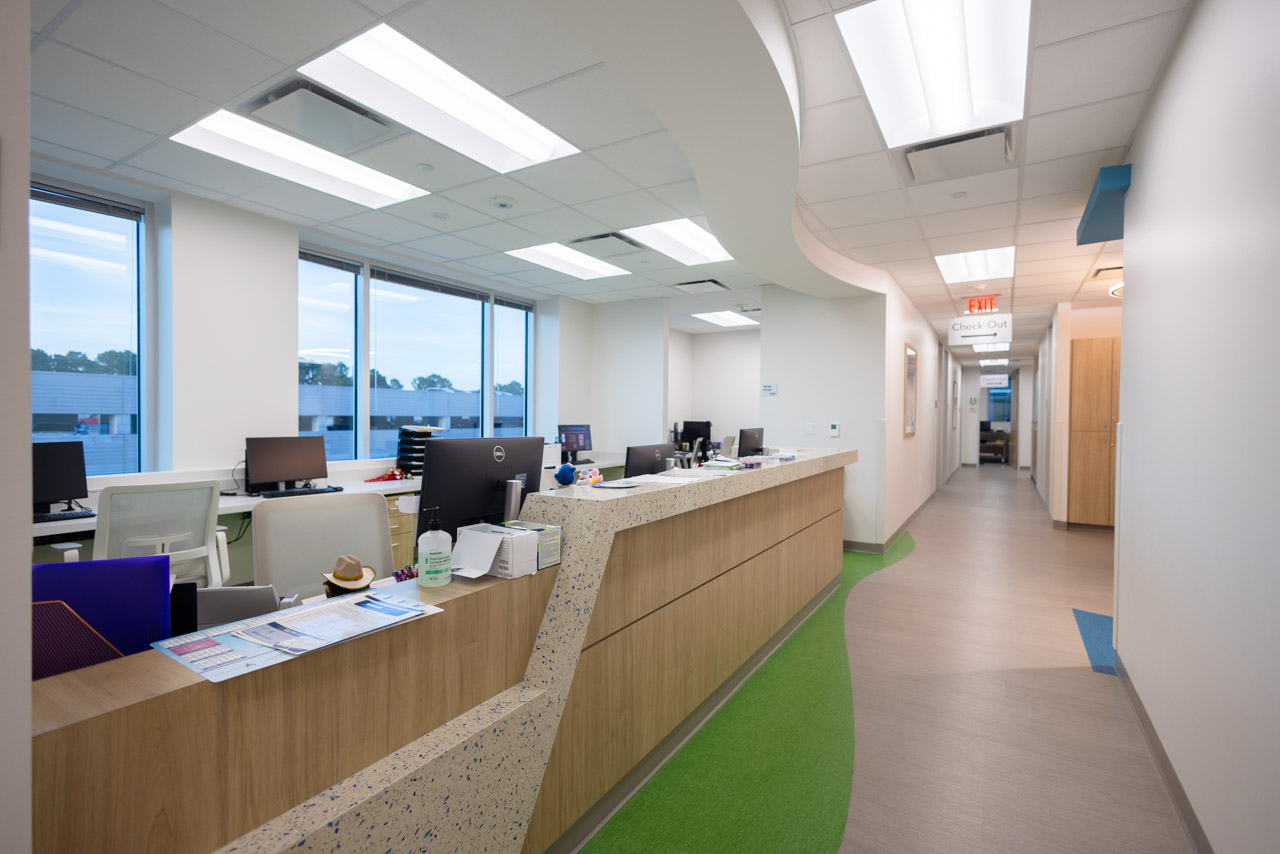
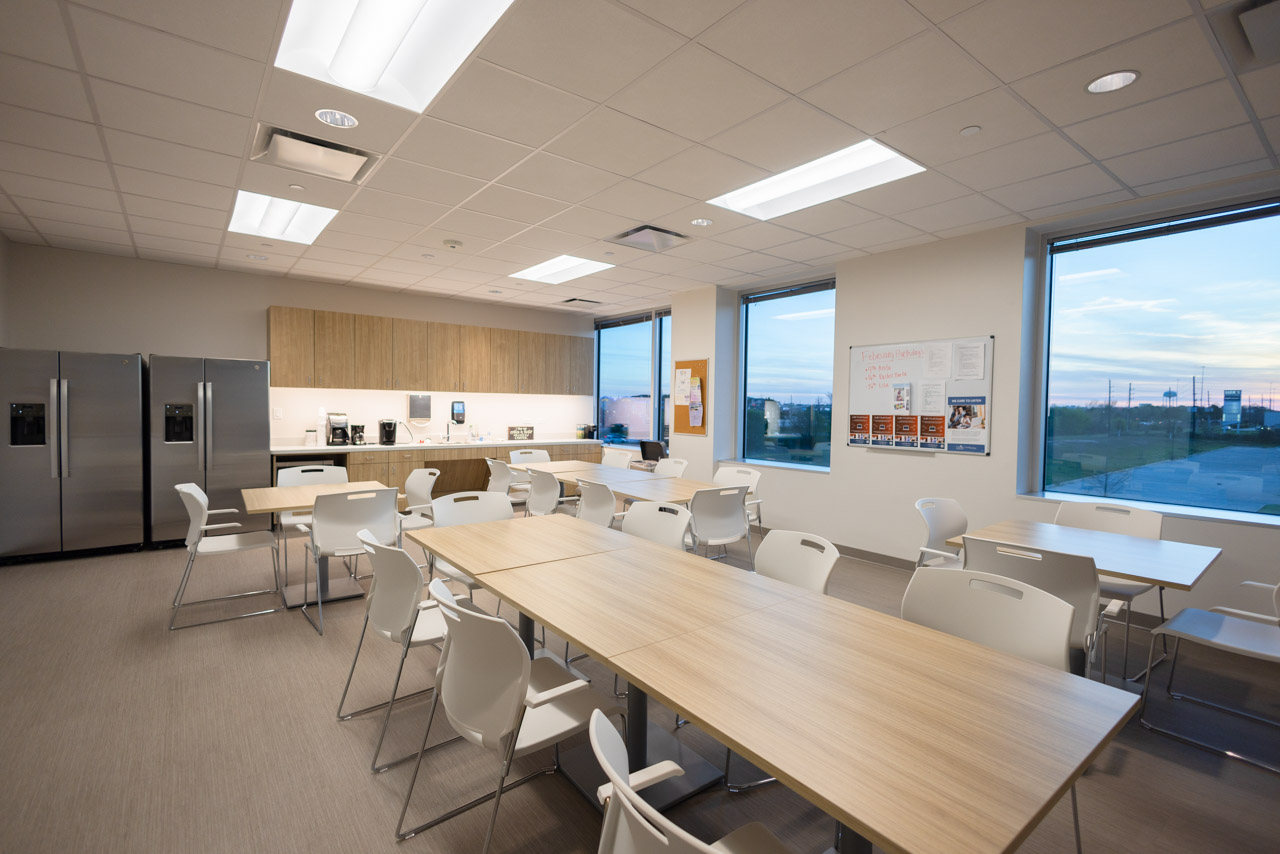
Five of the six nurses’ stations on the floor are positioned along the perimeter glass, giving clinical staff natural light and views throughout their shifts. Provider workstations are placed immediately adjacent, fostering direct communication between physicians and nurses without the friction of separated private offices.
“…No longer each guy has like a 10 by 15 office,” Kastendieck explained. “The interaction here is really important and this allows for that.”
The response from staff was immediate and enthusiastic for the open and bright spaces.
A Waiting Room That Doesn’t Feel Like One
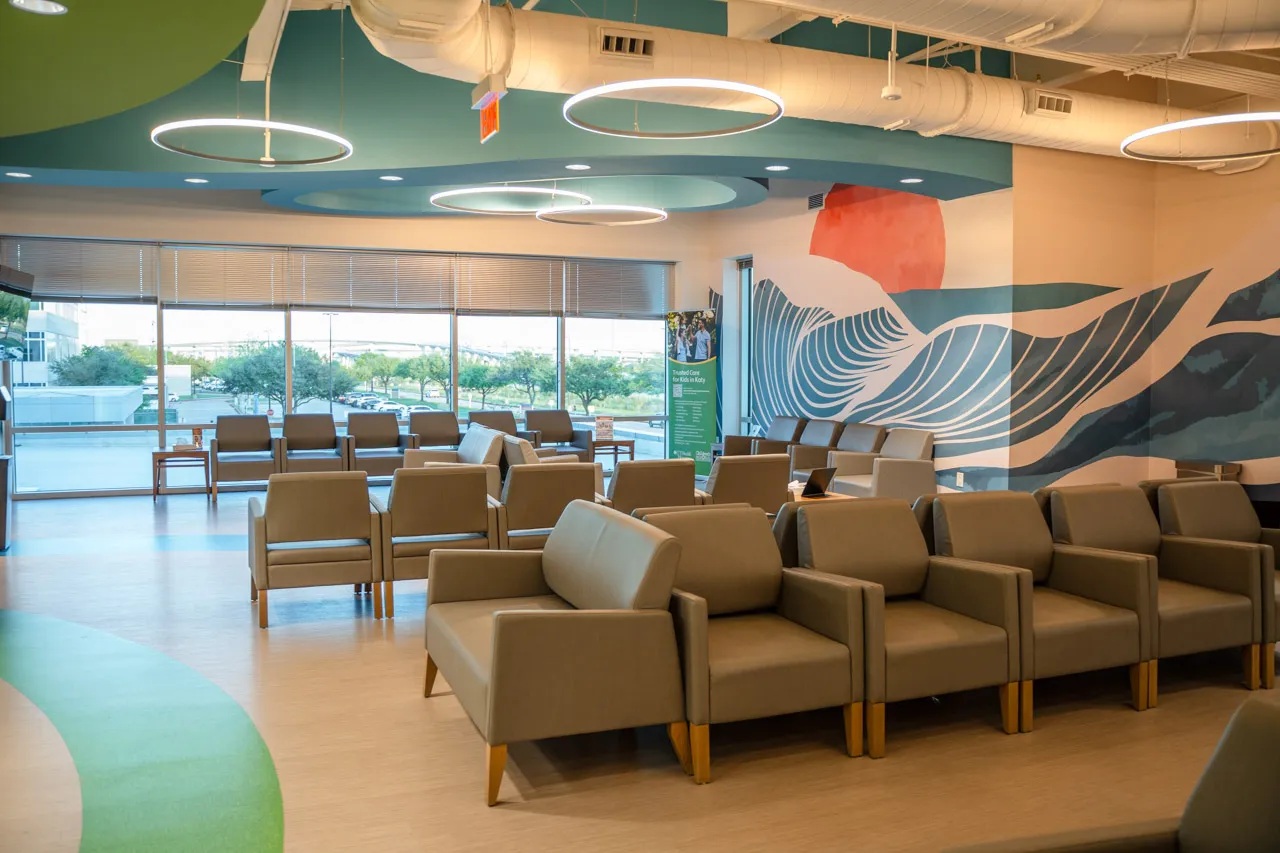
The waiting room was designed to serve both sides of the clinic simultaneously — the pediatric wing to the north, multispecialty to the south — and seats 40 to 50 people. Rather than default to a standard drop-ceiling layout, Identity removed the ceiling entirely.
“It made an opportunity to do exactly what you just see here — all of the different elements, lighting, fur-downs, ductwork, all kinds of come together in order to create, in my opinion, a much more exciting space for when folks get here,” Kastendieck said. “We’re not limited by the ceiling height.”
The exposed spiral ductwork was custom-replaced to be visually cohesive, and light fixtures were hung at varying heights to animate the volume. The result reads as soothing rather than clinical — deliberately so for a pediatric environment where children and anxious parents are the primary occupants.
Maximizing Every Square Foot
With medical real estate at a premium, Identity applied several strategies to extract maximum usable area from the floor plate. Shared utilitarian functions — labs, storage, toilets — were centralized on the interior, leaving the perimeter free for clinical spaces that benefit from light and visibility.
In the ENT clinic, where space constraints were most acute, sliding doors replaced traditional swing doors on exam rooms. “If you had a swing door in here, you’re taking up valuable floor space,” Kastendieck explained. “If you notice, they’re using every inch.”
Toilets were also positioned at corridor corners where possible, opening up the corner areas for better flow and reducing the pinch points that accumulate in high-traffic clinical environments.
Building for Growth From Day One
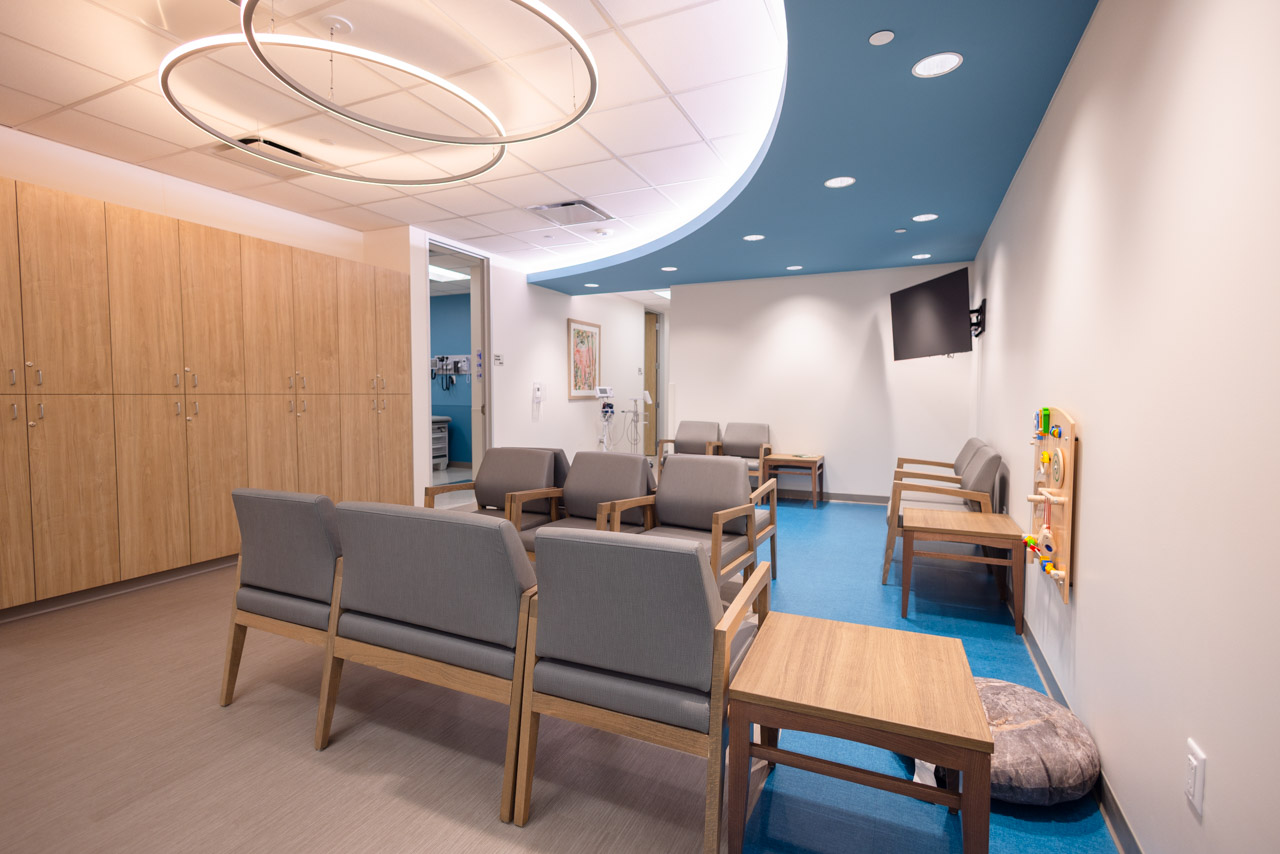
When programming began, the clinic only needed roughly half the floor to operate. The recommendation from Identity was to build it all out upfront anyway.
“Our concept was we’re gonna build it out as if it is all being used,” Kastendieck said. “I can’t look at it like, ‘I’m only gonna build out what you need right now, then I’m gonna leave a huge open space and fill that up later.’ It didn’t work that way.” Instead, the expansion spaces were built out as functional pods — fully finished and ready to activate when needed.
That decision also protected the budget. Phased build-outs require repeated mobilization, disruption to active clinical operations, and typically cost more per square foot than building out a contiguous space at once.
The Outcome
“I think Memorial Hermann was really shocked that it did get done for a lot less than they budgeted for,” Kastendieck said.
The design held up from concept to delivery as well. “If you went back and looked at the first sketch that we did for this space and compared to what we have right now, you’d be hard pressed to see a difference.”
Identity Architects is a Houston-based architecture firm specializing in commercial and medical projects. Our Architect-Led Design Build approach integrates design, construction documentation, and construction management under a single leadership team — from early visioning through project completion.