


Healthcare buildings occupy a unique place in the built environment.
Unlike many other building types, hospitals and medical facilities are rarely temporary. They become embedded within the communities they serve; places people return to throughout their lives. Generations of families pass through the same entrances, sit in the same waiting areas, and rely on the same institutions for care. Over time, these buildings have become part of a community’s collective memory.
Because of this permanence, healthcare architecture carries a particular responsibility.
These environments must do more than house clinical functions. They must hold the full complexity of human experience the anxiety of a waiting room, the quiet of a recovery space, the disorientation of navigating an unfamiliar building while carrying something heavy. Every corridor, every threshold, every moment of arrival shapes how a person feels before they have even reached the care they came for.
In this way, healthcare design is less about building types and more about building for people — people who deserve spaces that feel considered, calm, and worthy of the trust they extend to them.
In healthcare design, details matter, and so does care.
Clinical precision must coexist with human warmth. Regulatory compliance must be woven into spatial decisions that also serve patient comfort. Infrastructure, the systems that allow imaging equipment to function, that maintain air pressure between clinical zones, that protect patients during an active renovation, must perform invisibly so that the architecture can remain present.
When a facility is being renovated while care continues, this complexity deepens further.
Construction sequences must be planned around the rhythms of a living building. Decisions that might take days elsewhere must be made carefully and quickly. Every phase of work carries the awareness that somewhere in the same structure, someone is healing.
These are the realities that shape how we approach healthcare architecture at Identity. Not as a set of constraints to be managed, but as the conditions that make the work meaningful.
West Medical One is a good example of what this work looks like in practice.
Patients arriving for rehabilitation are not simply navigating a building. They are rebuilding their relationship with their own bodies often in the earliest, most uncertain stages of recovery. The environment around them either supports that process or quietly adds to its difficulty. A corridor that is hard to read, a threshold that is difficult to negotiate, a space that feels clinical rather than human these details matter here more than almost anywhere else in healthcare design.
The comprehensive renovation of this medical office building required careful rethinking of how patients and clinical staff move through a large, active medical environment without interrupting the care happening throughout the building. Every corridor, threshold, and treatment zone was considered through the lens of the people using it: patients arriving at different stages of recovery, with varying levels of mobility and independence, often navigating an unfamiliar environment while managing both physical effort and concentration.
The design focused on creating spaces that felt clear without being sterile, and accessible without becoming institutional. Wayfinding was shaped through the perspective of someone who may be moving slowly, with assistance, or relearning how to move through space altogether. Material choices, spatial proportions, and the relationship between treatment areas and places of rest were brought into dialogue with one another, supporting both clinical function and the human experience of recovery.
The project was recognized as a 2024 Crystal Award Finalist in the Rehabilitation and Renovation category and this acknowledgment reflect the care invested in every layer of the work.
Medical Facility Retrofits and the Expanding Definition of Care
Healthcare is not only delivered in hospitals. Increasingly, it is finding its way into the fabric of existing neighborhoods into buildings that were once offices, retail spaces, or single-use facilities quietly waiting to serve a different purpose. Retrofitting these structures for medical occupancy is, in many ways, an act of access. It allows clinical services to reach communities where new construction may never arrive — bringing imaging suites, specialty care, and diagnostic services closer to the people who need them. The existing building becomes a vessel for something new, without disappearing entirely.
Whether approached as a medical retrofit or a full adaptive reuse, the challenge is the same: healthcare occupancies carry technical requirements that most existing buildings were never designed to meet. Structural systems must accommodate equipment with precise tolerances. Mechanical infrastructure must be reconsidered entirely. Regulatory pathways must be engaged from the first conversation, not the last. When these considerations are part of the design process from the beginning, what appears complex becomes navigable.
THE EDLOE IMAGING CENTER
The Edloe Imaging Center began as an existing building with a strong location and a question worth asking: what could this become for the people around it?
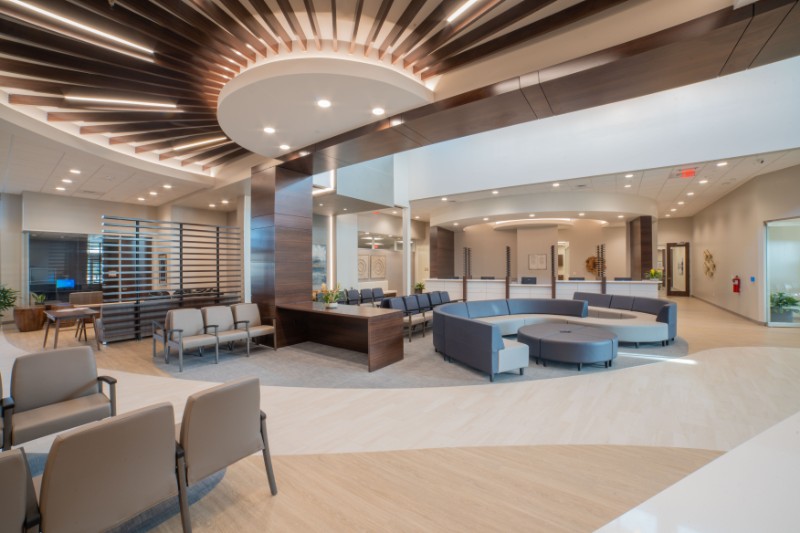
The answer was a fully integrated, multi-tenant diagnostic facility — MRI, CT, X-ray, and ultrasound services housed on the first floor, organized around a shared central lobby that connects three independent clinics. The technical work was significant. Shielding, vibration control, environmental systems, and regulatory coordination all required close attention. But the design intention was always simpler than the engineering beneath it.
Patients arriving for diagnostic imaging often carry uncertainty with them. A scan ordered to rule something out. A follow-up that required returning. The shared lobby was designed to receive people in that state — with clarity, with warmth, with a spatial sequence that moves from arrival to care without adding confusion to an already uncertain moment.
Three clinics. One arrival. One experience designed around the patient rather than around the building.
At Identity, healthcare architecture has always been rooted in a simple belief: that the spaces where people receive care should reflect the care itself.
That belief shapes how we approach every project the communication we maintain with owners and clinical teams, the attention we give to how a space will actually be experienced, and the way we stay invested in a project long after the design decisions have been made. Healthcare environments reveal themselves slowly through construction and operation. Staying present through that process, remaining responsive and aligned, is part of what it means to design them well.
What we offer is something we believe matters more to the right clients: relationships built on genuine trust, communication that is direct and consistent, and a delivery model that keeps design thinking and construction strategy connected from the very beginning. When you are working inside an active medical facility, that integration is not simply a preference — it is the only approach that protects the clinical environment and the people inside it.
Our core value as a firm is CARE and we mean it in the most literal sense. We care about the details that do not show up in a deliverable but determine whether a project truly succeeds. We care about the clinical staff who will work in the spaces we design, and about the patients who will move through them. And we care about whether what we deliver is genuinely excellent — not by our own measure, but by the measure of the people it was built for.
Healthcare architecture is not for everyone. It requires time, experience, and a real commitment to understanding environments that carry enormous responsibility.
There is something quietly meaningful about this work. The buildings we help shape will outlast the conversations that brought them into being. People will return to them across years and decades, in moments of routine and moments of significance. Over time, the architecture becomes familiar part of the background of someone’s life in a way that most design never reaches.
That is the responsibility healthcare architecture asks us to carry. And it is one we do not take lightly.