


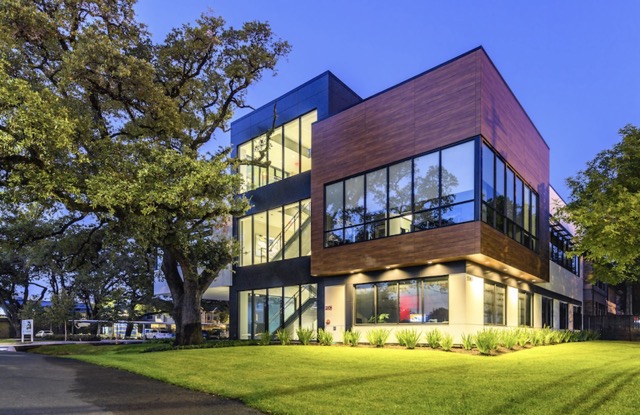
A polished architecture portfolio is designed to make a strong first impression. That matters, but it is only the starting point.
For owners and developers, the more important question is whether the work shown suggests that the firm understands the kind of project you are planning. That means looking beyond the most visually striking or polished image and paying attention to project type, scale, users, site conditions, and the problems the architects were asked to solve. Owners and developers want to know that they are designing for longevity, adaptability, and the human experience while using the building and site around it.
When reviewing a commercial architecture portfolio, the goal isn’t necessarily to find a building that you like, what it looks like, and stop there. It’s to identify that the firm not only designs well but also knows how to execute the design so that the rendering is what actually gets built. You want a firm that has long-standing, trusted relationships with general contractors and engineers, and has a designated person to navigate permitting for your specific site. A firm that coordinates and communicates well so that what gets designed gets built.
Explore Identity Architects’ portfolio
Table of Contents
Beyond the Visual Statement, the Project Needs to Perform
It can be reassuring to see a project that resembles what you have in mind, but visual similarity only tells you so much.
A retail developer may care more about whether a firm has previously worked with the proposed site’s city and planning. Do they know how to lay out a site to facilitate a successful proforma? Do they design thinking about how a building will endure through time and not just look good on ribbon-cutting day? A healthcare client may need architects who understand patient flow, staff needs, privacy, technical coordination, and future expansion. An owner renovating an existing property may want to see experience working with existing structures and ongoing operations.
In other words, the useful comparison is often about the challenge rather than the appearance.
As you review commercial architecture projects, look for parallels in building type, scale, program, site constraints, construction conditions, and users. Those details may be more meaningful than whether the finished project matches your preferred style.
Finding out those details will ensure you have a higher return on investment. It needs to not only look good, but perform well. A building or project performing well has everything to do with the continued coordination after the project has been designed. We want the owner/developers building to come out how they want it to look. Any architect can draw a pretty building – it’s the details of coordinating with consultants and functionality that make a pretty building turn into a high-performing asset for a developer.
Look at the Range of Work

A portfolio can show how a firm responds to different clients and contexts.
That doesn’t mean the firm with the widest possible range is automatically the better choice. What matters is whether the work suggests adaptability.
If every project follows essentially the same visual formula, it is worth understanding how the architects respond when the site, brand, budget, or operational needs change. A varied portfolio, on the other hand, may show that the design approach starts with the requirements of each project rather than applying the same look everywhere.
This is particularly relevant to commercial architecture design, where a medical office, neighborhood retail center, workplace, and mixed-use development can call for very different solutions.
See what goes into commercial architecture beyond appearance
Look for Signs of Real Project Complexity
Finished photography usually makes architecture look resolved and effortless. The difficult parts of the project are often less visible.
That’s why the information accompanying a project matters too.
Consider whether the project was ground-up or adaptive reuse, whether construction involved multiple phases or ongoing operations, and whether several uses or stakeholder groups had to be coordinated.
Those details put the images in context.
A visually simple building may have required considerable technical coordination, while a more dramatic design isn’t automatically evidence of greater complexity.
If the portfolio doesn’t explain much about the project, that becomes something to discuss with the architects. Ask what made the work challenging, how those issues were addressed, and what role the firm played.
Consider How the Project Works for Its Users

A portfolio cannot tell you everything about how a completed building performs, but there are still practical details worth observing.
Look at how people appear to approach and move through the project. Entrances should be understandable. Retail storefronts may need visibility from important approaches. Outdoor areas should feel connected to the uses around them rather than occupying leftover space.
Different project types bring different priorities. A healthcare facility may need to support clear patient and staff circulation, while a retail or mixed-use development might depend more heavily on pedestrian connections, tenant visibility, gathering areas, and the relationship between indoor and outdoor spaces.
The point isn’t to reverse-engineer an entire project from a handful of images. It’s simply to look for signs that the architecture was shaped around how people would actually use it.
Strong commercial architecture projects should respond to more than appearance. They should also support the activities, operations, and people inside and around them.
See how placemaking supports everyday use
Use the Portfolio to Decide What to Ask Next
A portfolio is a useful starting point, but it doesn’t give you the full picture of an architecture firm.
It won’t tell you how well the team communicates, how they respond when budgets change, how effectively they coordinate with consultants and contractors, or what working with them will be like over the course of a project.
What it can do is help you ask better questions.
You might want to know which completed projects the architects consider most comparable to yours and why. You can ask about the biggest constraints behind a particular project, the firm’s scope of work, whether construction was phased, or how the client’s operational needs affected the design.
Those conversations move the evaluation beyond “Do we like this building?” toward something more useful: “Does this experience relate to what we’re trying to accomplish?”
For owners comparing architecture firms, that’s a better way to put a portfolio to work.
Look for Evidence, Not Just an Aesthetic
The strongest portfolio isn’t necessarily the one containing the building you would most like to copy.
A more useful portfolio gives you evidence of relevant experience, adaptability, problem-solving, and an understanding of how architecture supports the people and businesses using it. Just as importantly, it gives you a clearer idea of what to ask before deciding whether the firm is right for your project.
Identity Architects’ portfolio includes commercial, healthcare, retail, placemaking, office and mixed-use work across a range of project conditions. Explore the portfolio to see how different project needs have shaped the firm’s approach, and to start thinking about what your own project will require.